Panax vietnamensis Ha & Grushv.
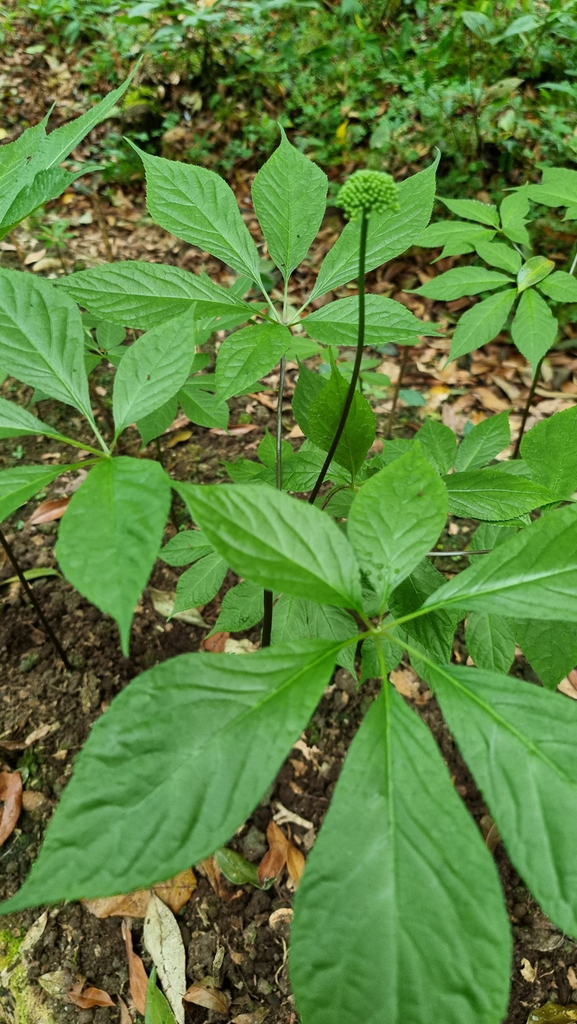
- Family
- Araliaceae (genus Panax)
- Occurrence records
- 5 inside the Mekong basin · 59 in the six basin countries
- Countries with records
- China, Vietnam
- Countries in the ethnobotanical inventory
- Vietnam
- Life form
- Herb
- Parts used
- Root
- Evidence grade
- A source category supported by at least two distinct verified DOI sources; D means insufficient verification
- IUCN category
- – (national red list)
- CITES appendix
- not listed
- Sensitive species
- Coordinates of its records are generalised: IUCN EN
- Synonyms
- Panax vietnamensis var. fuscidiscus K.Komatsu, S.Zhu & S.Q.Cai
- Macroecological context
- Among this taxon's countries, Vietnam is a medicinal-diversity hotspot (residual +1810.6, p = 0.00104)1
¹ Shrestha et al., The human fingerprint of medicinal plant species diversity, Current Biology (2025), doi:10.1016/j.cub.2025.09.050. - External databases
- GBIF · Plants of the World Online · World Flora Online
Distribution
Filled markers are specimen-based records, hollow markers are observations. The dashed outline is the Mekong basin boundary.
Open in the explore map · 54 further records from the same countries lie outside the basin
Ethnobotany (1 use record)
Use categories: other (1)
Evidence grades: A 1
Headline summary only. Record-level detail (uses, assays, potencies and sources) is held in the restricted Mekong Evidence Pipeline and is available from the authors on request.
Pharmacology (4 records)
0 extract assays · 4 isolated-compound records
Evidence grades: A 2 C 2
Headline summary only. Record-level detail (uses, assays, potencies and sources) is held in the restricted Mekong Evidence Pipeline and is available from the authors on request.
Conservation and trade
- IUCN category
- – (national red list)
- Threat status
- Endangered (Vietnam Red Data Book); endemic to Việt Nam's Annamite cordillera (Ngọc Linh massif)
- CITES
- Not CITES-listed. Only Panax ginseng and P. quinquefolius are Appendix II (annotation #3, roots and whole plants); P. vietnamensis has no CITES listing
- Trade
- Very high domestic and cross-border value; 15,000 ha planted in Nam Trà My district, Quảng Nam; expansion to ~19,000 ha reported
Sustainability
Screening layers from the hydroclimatic synthesis of Tiwari et al. 2023 (Zenodo 7803254); methods are linked from the Sustainability page.
| Climate vulnerability | not assessed | fewer than 10 occupied 5 km in-basin cells — insufficient data for SDM |
|---|---|---|
| Cultivation feasibility | in progress | analysis in progress |
| Harvest pressure | low (demographic proxy, no use data) | mean proxy 0.0 across 5 cells; a proxy, not measured offtake |
| Hydrological vulnerability | low | 0.0% of 5 in-basin records within 10 km of a major dam (distance-based proxy) |
Bioeconomy
No bioeconomy profile available for this taxon. The bioeconomy screening layer catalogues value-chain, trade, certification and livelihood evidence only where a citable study covers the taxon; in this release no atlas taxon is covered by the two value-chain studies retrieved, so no profile exists yet. See the Data catalog and Methods.
Phytomedicine
Database and literature retrieval for screening, not a claim of efficacy or safety. See the Phytomedicine page for the rules.
| Discovery stage | Bioactive compound (common) |
|---|---|
| Compounds (COCONUT) | 89 |
| Bioactive / distinctive bioactive | 4 / 0 (2 potent ChEMBL targets) |
| Clinical-phase compounds | 2 |
| Registered studies | 0 |
| Ethnobotanical convergence | 0/3 use records name no basin country for a comparable category |
| Ethnopharmacology literature | 2/4 7 Europe PMC papers with an ethnopharmacology term (5 naming a basin country) · 0 in J. Ethnopharmacol. · 78 papers in all |
| Bioeconomy potential | low 1/6 |
| Structural alerts | none found |
| LiverTox sections | 0 |
| Genome / Rhea compounds | 0 assemblies · 8 Rhea compounds |
| Nagoya status of range | Party: VN · not a Party: – |
| Supply-risk flags | destructive-harvest (unknown: IUCN category) |
| Substitute congeners | 8 |