Punica granatum L.
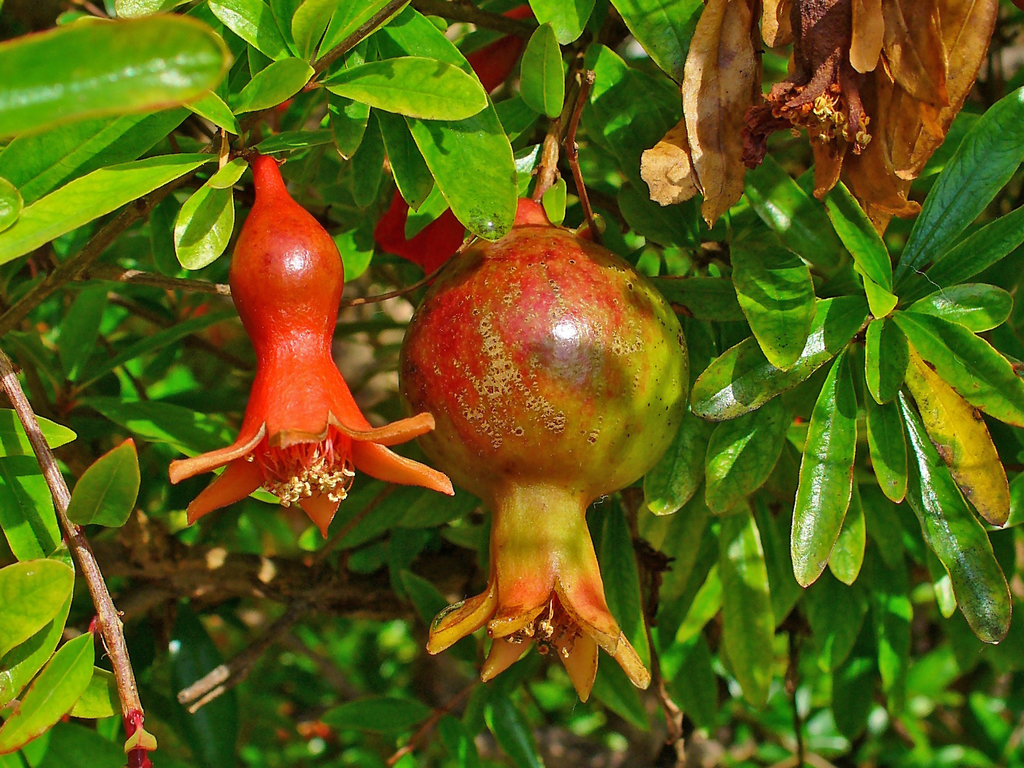
- Family
- Lythraceae (genus Punica)
- Occurrence records
- 43 inside the Mekong basin · 1,179 in the six basin countries
- Countries with records
- China, Thailand, Vietnam, Laos, Cambodia, Myanmar
- Countries in the ethnobotanical inventory
- Thailand, Laos, Cambodia, Vietnam, Myanmar
- Life form
- Shrub
- Parts used
- Fruit, rind, root
- Evidence grade
- D source category supported by at least two distinct verified DOI sources; D means insufficient verification
- IUCN category
- LC (GBIF iucnRedListCategory)
- CITES appendix
- unknown
- Synonyms
- Granatum punicum (L.) St.-Lag.; Punica florida Salisb.; Punica granatum f. albescens (DC.) Rehder; Punica granatum f. flavescens (Sweet) Rehder; Punica granatum f. legrelliae (Lem.) Rehder; Punica granatum f. multiplex (Sweet) Rehder; Punica granatum f. plena Voss; Punica granatum f. pleniflora (Hayne) Rehder; Punica granatum var. acidula Risso; Punica granatum var. alba Risso; Punica granatum var. albescens DC.; Punica granatum var. flava Loudon …
- Macroecological context
- Among this taxon's countries, Thailand is a medicinal-diversity hotspot (residual +1684.6, p = 0.00228); Laos is a medicinal-diversity hotspot (residual +1168.1, p = 0.03441); Cambodia is not significantly above expectation (residual +993.8, p = 0.07193); Vietnam is a medicinal-diversity hotspot (residual +1810.6, p = 0.00104); Myanmar is a medicinal-diversity hotspot (residual +2203.5, p = 7e-05)1
¹ Shrestha et al., The human fingerprint of medicinal plant species diversity, Current Biology (2025), doi:10.1016/j.cub.2025.09.050. - External databases
- GBIF · Plants of the World Online · World Flora Online
Distribution
Filled markers are specimen-based records, hollow markers are observations. The dashed outline is the Mekong basin boundary.
Open in the explore map · 1,136 further records from the same countries lie outside the basin
Ethnobotany (1 use record)
Use categories: gastrointestinal (1)
Evidence grades: C 1
Headline summary only. Record-level detail (uses, assays, potencies and sources) is held in the restricted Mekong Evidence Pipeline and is available from the authors on request.
Sustainability
Screening layers from the hydroclimatic synthesis of Tiwari et al. 2023 (Zenodo 7803254); methods are linked from the Sustainability page.
| Climate vulnerability | stable | projected range change -8.28% (conditional scenario projection); AUC 0.6339, TSS 0.439; low-confidence (auc<0.7 or tss<0.4) |
|---|---|---|
| Cultivation feasibility | low | 27150.0 km² feasible (screening) |
| Harvest pressure | high (demographic proxy, no use data) | mean proxy 0.005256 across 37 cells; a proxy, not measured offtake |
| Hydrological vulnerability | low | 9.3% of 43 in-basin records within 10 km of a major dam (distance-based proxy) |
Bioeconomy
No bioeconomy profile available for this taxon. The bioeconomy screening layer catalogues value-chain, trade, certification and livelihood evidence only where a citable study covers the taxon; in this release no atlas taxon is covered by the two value-chain studies retrieved, so no profile exists yet. See the Data catalog and Methods.
Phytomedicine
Database and literature retrieval for screening, not a claim of efficacy or safety. See the Phytomedicine page for the rules.
| Discovery stage | Registered clinical study |
|---|---|
| Compounds (COCONUT) | 371 |
| Bioactive / distinctive bioactive | 65 / 1 (751 potent ChEMBL targets) |
| Clinical-phase compounds | 43 |
| Registered studies | 170 |
| Ethnobotanical convergence | 2/3 5 countries share a use category |
| Ethnopharmacology literature | 4/4 163 Europe PMC papers with an ethnopharmacology term (3 naming a basin country) · 45 in J. Ethnopharmacol. · 2,260 papers in all |
| Bioeconomy potential | high 4/6 |
| Structural alerts | none found |
| LiverTox sections | 0 |
| Genome / Rhea compounds | 15 assemblies Complete Genome · 56 Rhea compounds |
| Nagoya status of range | Party: LA,KH,VN,MM · not a Party: TH |
| Supply-risk flags | destructive-harvest; high-harvest-pressure (unknown: CITES appendix) |
| Substitute congeners | 0 |